Appendix 1: Requirements for product lines, lead times and packaging sizes
A good range of contracts and a robust supply concept should help hospitals get the goods they need for patient care. Suitable packaging sizes from suppliers contribute to efficient operation and minimal scrapping.
Product line
Products under contract must generally comply with the logistics terms and conditions
Logistics mapping
As part of the market dialogue during the tendering process, it may be necessary to map the logistics processes.
The purpose is to uncover any issues between the customer and the suppliers that may impact the request for tender, implementation and operations monitoring.
Examples of topics will be available on the joint website under Templates and contract documents – Logistics terms and conditions.
Purchasing and logistical system
The selected goods under contract shall be added to the purchasing and logistical systems of the customer, available to the hospital trusts and supply centres.
These are “stock goods”, which are normally purchased and kept permanently in stock, or “special order goods”, which are purchased as needed.
Stock monitoring and demand forecasting
The supplier must build a sufficient stock of goods before the contract takes effect and maintain such stock throughout the contract period. Special requirements for enhanced security and contingency stockpiles may be included in the request for tender.
Goods under contract will be categorised from 1 to 5 in accordance with the [asset criticality hierarchy].
The supplier and the customer shall reconcile goods purchases and demand forecasts as needed
Consignment stock
For some types of goods, the supplier will be required to maintain a consignment stock owned by the supplier.
The terms and conditions for purchase and delivery will be specified in the request for tender and the consignment stock appendix. The template is available [here]
General lead times for purchases
Lead times indicate the time it takes from a purchase order has been submitted by the customer, within the agreed time limit and received by the supplier, until it has been delivered to the customer. Lead times are specified in business days.
Purchase orders submitted within the supplier’s purchase deadline must be processed the same day.
Day 0 is the day the purchase order is received (e.g. Monday). Day 1 is when the lead time begins (e.g. Tuesday). If the agreed lead time is 5 business days, the last day of delivery in accordance with the lead time would be day 5 (e.g. Monday).
The supplier must comply with a general lead time of no more than three (3) business days for regular purchases by hospital trusts in Helse Sør-Øst.
The supplier must comply with a general lead time of five (5) business days for Helse Vest, Helse Midt-Norge and Helse Nord-Norge.
This shall apply unless other terms have been agreed in writing between the supplier and the customer in the procurement agreement.
For goods to the individual hospital trusts, each customer and the supplier may agree special delivery schedules as needed.
Lead times to supply centres
The regional supply centres and the supplier may agree on special purchase and delivery schedules, with fixed delivery dates and times.
Criticality type «1» |
Products that could cause serious downtime and, in the worst case, loss of life and health if the supplier is unable to deliver. If an inability to deliver occurs, follow-up must be prioritized immediately. Examples are equipment-dependent cosumables, invasive pressure sets, etc. |
Criticality type «2» |
Products that are key to patient care, but do not have the same consequences as with a lack of criticality type "1" mentioned above. For type 2 there are alternative suppliers of the product, but special training may be required before the products can be used. Examples are suture machines, vein flons, specially ordered procedure packages etc. |
Criticality type «3» |
Products for patient care where there is a replacement that can cover the need without this disrupting operations to a large extent. Examples are bandages, wound products, etc. |
Criticality type «4» |
Other products that are used in the care of the patients, but there are alternative products on the market elsewhere. Examples are nappies, waste bags, care products, etc. |
Criticality type «5» |
Products that are not used in patient treatment or patient care Substitutes for these products can be obtained in the general market. Examples are toilet and paper towels, printers and office supplies. |
General
New hospitals are often built without central warehouses. Both new and older hospitals currently have small warehousing and supply facilities for equipment and supplies needed for patient treatment and related operations.
Ward-based logistics describes an order comprising multiple co-packaged goods, delivered in consumer units (CU), which can be deposited directly into cupboards and shelves in the supply rooms without requiring local storage, splitting or repackaging.
Sales units, consumer units and primary packaging
Sales units and individual primary packages/consumer units (CU) should, at minimum, be held by packaging suited for delivery to the hospitals in accordance with the requirements that apply to ward-based logistics. Packaging quantities are important considerations for space utilisation and preventing product waste.
Packaging must comply with the requirements outlined in Appendix 2 “Physical requirements” and must be approved by the manufacturer.
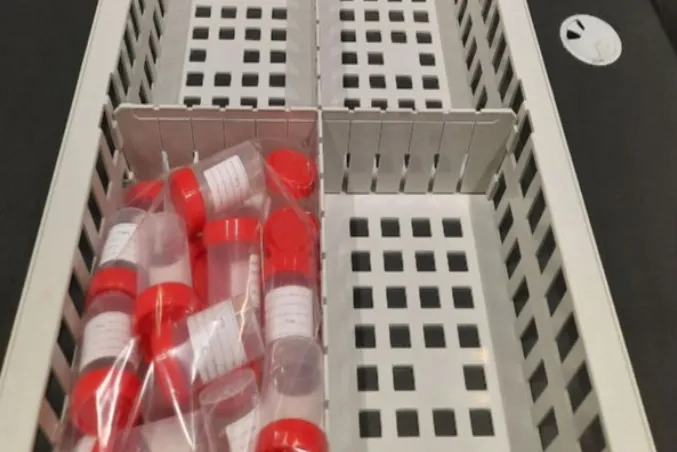
The size of the consumer unit should normally not exceed approx. 1/2 drawer (up to approx. 6–12 litres).
For liquid or heavy products, the sales unit cannot exceed 10 kg.
See description [here]
Requirements for maximum packaging size for consumer units may be specified and evaluated in the request for tender and apply to deliveries to the supply centre and to the hospital trusts.
Additionally, packaging size requirements shall take into consideration certain categories of goods are subject to international packaging standards.
Supply rooms in the hospitals for articles close to the patient
See picture 1 below.
When changing and upgrading supply rooms, standard sizes of drawers, cupboards and shelves will be followed for the purchase of new cupboards or drawers.
Products that fit in a drawer will be stored in this solution. Examples are products such as syringes, surgical equipment, wound treatment equipment, liquids etc. where you normally replenish new items 2-5 times per week.
Products that, either in volume or dimensions or consumption, are larger than an entire drawer are stored on separate shelves. Examples of this are large plastic containers, paper towels, clothing, crutches, nappies, copy paper, etc.
Standard drawers and cabinets
The cabinets consist of drawers with the dimensions: 10cm (h) x 40 cm (w) x 60 cm (d) or 20cm (h) x 40 cm (w) x 60 cm (d).
A minimum APL packaging (consumer unit) must be in an appropriate amount based on a normal consumption pattern in hospitals.
It should not be larger than a maximum of 1/2 drawer (up to approx. 10-12 litres) unless otherwise agreed. See example in picture 2.
Shelves
The shelves are normally 80-100 cm wide. A minimum packaging volume (F-pack) should not exceed 30 cm (h) x 40 cm (w) x 40 cm (d) unless otherwise agreed in the requirements specification
For liquid heavy products, sales packaging must not consist of products heavier than 10 kg