
The purpose of user involvement
Users can contribute a different perspective in research based on their own experiences with a condition or disease, and through their use of healthcare services. Collaboration between researchers and users can therefore provide a more comprehensive understanding of the field being studied.
User involvement can help ensure that research is directed toward areas where there is a recognized need for more knowledge from the users’ perspective, and that research results are put into practice more quickly.
Users should have the opportunity to influence and share responsibility for the direction of health research funded by public resources.
Who are users?
Users are usually patients or relatives, and they should preferably be represented through a patient or user organization in a research project. In some cases, healthcare professionals may also be considered users (for example, in the development of new methods).
Users can participate in different phases of a research project and/or at a more overarching, strategic level in advisory and decision-making bodies.
Recruitment of users
Users should be recruited and involved as early as possible in a research project, preferably well before the project starts so they can participate from the planning phase.
If the research project has a clearly defined target group, it is most appropriate to contact a patient or user organization closely related to the field of study. The organization can then suggest relevant users for the project.
If the project addresses a more general issue, one may, for example, contact the hospital’s user committee or an umbrella organization covering several associations/organizations (e.g., SAFO, FFO, etc.).
Note: Patients/study participants in a clinical trial are not considered users.
User involvement in research projects
For user involvement to function well, it must be perceived as important and useful for both users and researchers. It requires good dialogue and cooperation throughout the project period. Before the project starts, roles and expectations should therefore be clarified so that both researcher and user share a common understanding of their roles and what the user can contribute.
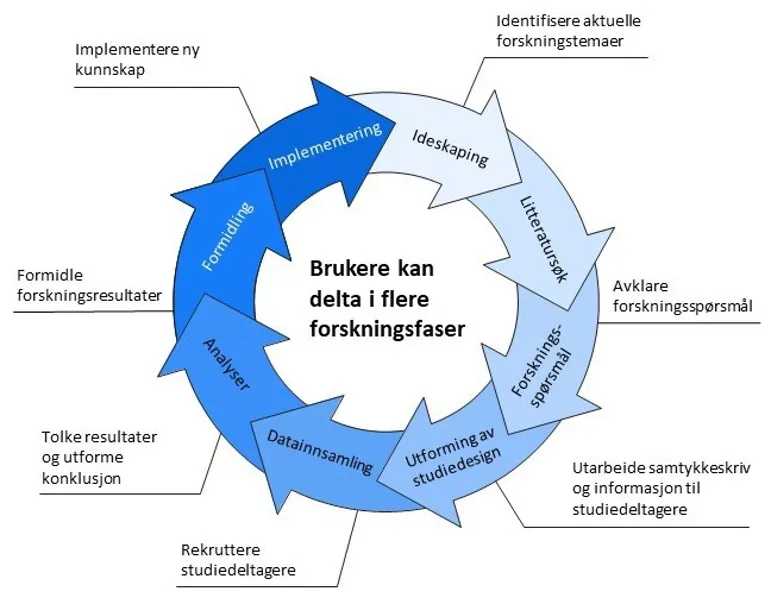
Users can often contribute to several phases of a research project, depending on the type of study. Below are some examples of possible user participation:
In the Planning Phase:
- Identification and prioritisation of research themes
- Formulation of consent forms and information materials for patients/study participants
- Designing the study
In the Implementation Phase:
- Process for data collection
- Interpretation of analyses/research results
In the Closing Phase:
- Dissemination of research results
- Implementation of new knowledge
- Evaluation of the research project
Compensation
Requirements for user participation in research projects
User involvement must be described in all applications for regional research funding from the South-Eastern Norway Regional Health Authority (Helse Sør-Øst RHF). If user involvement is not included in the research project, the reason for this must be explained.
Active user involvement is, however, required in research projects within prioritized areas and for projects receiving strategic research funding for non-university hospitals.
National guidelines for health research in specialist healthcare services
The four regional health authorities have developed national guidelines for user participation in health research, which provide a more detailed description of user participation in research projects.
See National Guidelines for User Participation in Health Research in Specialist Healthcare Services